
 Definition:
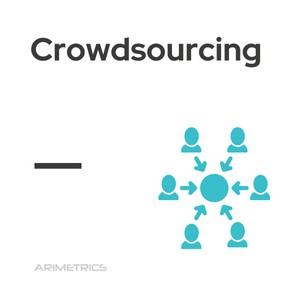
Crowdsourcing is a collaboration model in which an organization issues an open call to a broad group to obtain ideas, data, content, work, or solutions. The sponsoring organization defines the objective and rules, while participants contribute voluntarily, for payment, or in exchange for other incentives.
Digital platforms make it possible to coordinate contributions from different places and backgrounds, but technology is not what defines the model. Its central feature is the open participation of a community instead of assigning the task to a previously selected provider or an internal team.
Origins and operation of crowdsourcing
The term became popular in 2006 through Jeff Howe’s article The Rise of Crowdsourcing. The combination of crowd and outsourcing described a way to distribute tasks among participants connected through an open call. The concept has evolved and now covers voluntary contributions as well as paid challenges, microtasks, and collaborative projects.
A crowdsourcing initiative requires more than asking for opinions online. Its basic process usually includes these stages:
- Challenge definition: The organization specifies the problem, expected result, and conditions that contributions must meet.
- Open call: The challenge is communicated to an existing community or a broad group of potential participants.
- Contribution intake: The platform records ideas, designs, data, completed tasks, or other inputs required by the project.
- Evaluation and integration: A team, a vote, or technical rules are used to review, select, and combine the results.
- Recognition or reward: Participants receive attribution, access, prizes, payment, or other incentives defined in advance.
The crowd does not replace the responsibility of the project organizer. The sponsoring organization retains the final decision over criteria, moderation, quality, and the use of contributions.
Types of crowdsourcing
The model takes different forms depending on the requested outcome and the relationship with the community. One initiative may combine several types as long as its participation objective remains clear.
- Ideas and innovation: Problems or challenges are opened to concepts, designs, product proposals, or technical solutions.
- Microtasks: A large job is divided into small units such as classifying images, transcribing text, or verifying data.
- Collaborative content: The community creates, corrects, or expands resources such as maps, knowledge bases, and document collections.
- Open contests: Multiple people submit solutions and the organization selects one or more under published rules.
- Distributed testing: Participants using different devices and contexts evaluate a product. Crowdtesting is a specialized application of this approach.
Crowdfunding also mobilizes a crowd, but its main purpose is to obtain funding. It can therefore be related to crowdsourcing without making every financial contribution a crowdsourcing activity.
Crowdsourcing in digital marketing
In digital marketing, crowdsourcing can collect creative proposals, names, visual assets, stories, or improvement ideas. A participatory campaign creates a framework for community contributions, but the brand should explain how it will select and reuse the submitted material.
It can also help explore problems or identify uses that the internal team had not anticipated. However, an open call is not the same as a focus group: the latter uses selected participants and a moderated format, while crowdsourcing seeks distributed participation from a potentially broader group.
Contributions do not automatically represent the target audience. Self-selection, access to the channel, incentives, and challenge rules affect who participates and what responses are received. Results should therefore be interpreted according to the recruitment context, not treated as a statistical sample by default.
Managing a crowdsourcing initiative
The quality of the outcome depends on how the call is designed and managed. A large number of responses may increase variety, but it also requires resources for moderation, verification, and integration. Management should cover at least these operational elements:
- Scope and criteria: A clear briefing defines the problem, format, schedule, and evaluation method.
- Participation and incentives: Conditions should state who can participate, what recognition is available, and how ties or rejected entries are handled.
- Intellectual property: The rules need to clarify licensing, attribution, transfer of rights, and later use of proposals.
- Privacy and security: Collecting personal data, files, or sensitive information requires controls appropriate to the project.
- Quality and communication: The organization needs to detect duplicates, fraud, or errors and communicate the outcome to the community.
Crowdsourcing does not eliminate labor costs. It may require a platform, coordination staff, prizes, expert review, and participant support. Its value lies in opening a problem to a diversity of contributions, not in guaranteeing a free solution.
Examples and limitations of crowdsourcing
Collaborative knowledge and mapping projects illustrate an accumulative form: many small contributions build a shared resource. Citizen science applies the model to tasks such as classifying observations or collecting data. In open innovation, organizations such as NASA have used challenges aimed at external participants to seek solutions to specific problems.
Other projects request designs, code, translations, or product improvements and select only some submissions. In these cases, the call should prevent the requested effort from becoming disproportionate to the reward and should explain what will happen to unselected work.
The breadth of a community can provide diverse knowledge, but it does not guarantee accuracy, originality, or representativeness. Participation bias, uneven quality, rights over submitted materials, and the need for verification are structural limitations. A well-governed project combines openness with rules, review, and a transparent relationship with contributors.