Definition:
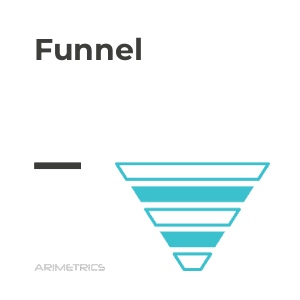
A funnel is a model that organizes the stages a group of people passes through from an initial point to a defined goal, such as registering, requesting information or making a purchase. It is used in marketing, sales and product analytics to measure how many people progress between steps and where their number decreases.
The funnel shape represents this progressive reduction, but it does not mean that everyone follows a linear path or that every drop-off is a problem. A funnel is an analytical representation built from specific stages and conditions.
Table of contents
How a funnel works
For the analysis to be interpretable, the funnel must specify:
- Goal: the final action to be observed.
- Population: the users, sessions, leads or opportunities included.
- Stages: the actions or states that form the path and their order.
- Time window: the maximum period in which the steps must be completed.
A funnel can be closed, counting only people who enter through the first stage, or open, allowing people to enter at later steps. It can also require consecutive actions or permit intervening actions. These rules change the results, so they should be documented before periods, segments or channels are compared. Google’s documentation on funnel explorations in Google Analytics applies these distinctions to event analysis.
Funnel types and stages
The term is used for related but distinct models:
- Marketing funnel: represents progression from awareness of a brand to interest, consideration and a measurable response.
- Sales funnel: organizes the development of a commercial opportunity from identification and qualification to closing.
- Conversion or product funnel: measures a specific sequence of actions within a website, application or service until a goal is reached.
There is no single stage sequence that fits every funnel. In content marketing, the path is often grouped into three areas:
- TOFU: the top of the funnel, focused on discovery and initial acquisition.
- MOFU: the middle of the funnel, associated with consideration and evaluation of alternatives.
- BOFU: the bottom of the funnel, close to a decision or conversion.
Other frameworks, such as AIDA or AARRR, can inform the stages, but they are not universal synonyms for a funnel. AARRR, for example, is a lifecycle framework that groups acquisition, activation, retention, revenue and referral.
How a funnel is measured
Metrics depend on the goal and unit of analysis. Common measures include:
- Stage volume: the number of people or items that meet each condition.
- Step conversion: the percentage that moves from one stage to the next.
- Overall conversion: the percentage that reaches the goal relative to the starting point.
- Drop-off: the difference between those who complete one step and those who reach the next.
- Time between stages: the average or distribution of the time required to progress.
The conversion rate between two steps is calculated by dividing the number that reaches the second by the number that completed the first. A decrease indicates a possible funnel leak, but it does not establish a cause on its own. It may result from friction, lack of interest, measurement errors, differences in intent or a person continuing through another path.
How to create and optimize a funnel
The usual process includes these steps:
- Define a conversion: choose an observable action that matters to the business or product.
- Select necessary stages: include only steps that represent genuine progress toward the goal.
- Configure measurement: validate events, identities, order, time windows and entry rules.
- Segment the results: compare channels, devices, cohorts or user types without mixing incompatible populations.
- Investigate drop-offs: combine quantitative data with usability testing, qualitative research and technical review.
- Test changes: state a hypothesis, modify a controlled element and measure whether the result improves without harming other metrics.
Reducing the number of steps does not guarantee an improvement. Some stages provide information, security or qualification and may be necessary. Optimization should consider both progression and the quality of the final outcome.
Funnel and customer journey
A funnel and a customer journey describe related aspects, but they serve different purposes:
- Funnel: quantifies how a population progresses through defined stages toward a goal.
- Customer journey: represents interactions, needs, expectations and touchpoints before, during and after a relationship with a brand.
- Combined use: the funnel locates where aggregate behavior changes, while the customer journey helps provide context for what may be happening in that part of the experience.
A funnel simplifies reality to make it measurable. Its conclusions therefore depend on data quality, stage definitions and whether the model adequately represents the process being analyzed.