
Table of Contents
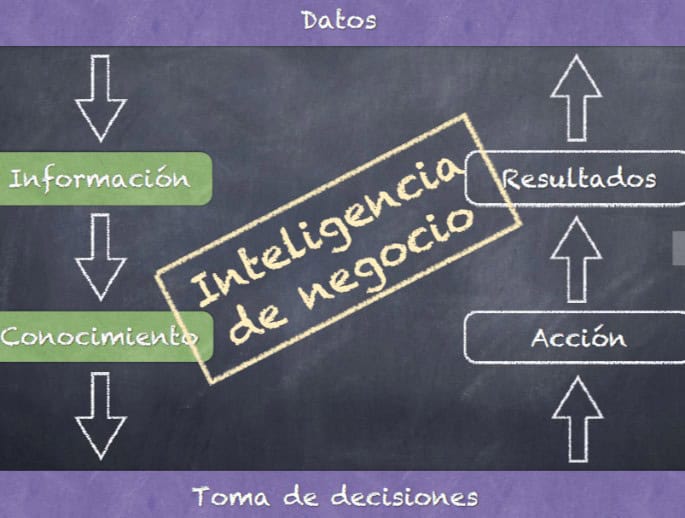
1. What is Business Intelligence?
Índice de contenidos
2. How to choose a Business Intelligence tool?
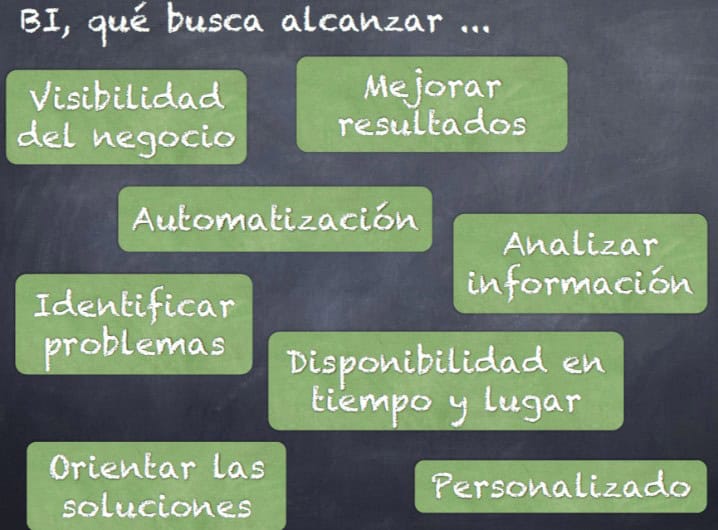
Questions that arise in a corporation when deciding to invest in BI tools:- Which products are the ones that generate the greatest benefits for me? = Promotion.
- What products are purchased by customer segments with common characteristics? = Marketing campaigns.
- What products trigger your sales at certain dates or times of the year? = Stock Optimization.
- What are the characteristics of my 5% most profitable customers? = Loyalty.
- Which promotions generate the most repetition of purchase among my customers? = Campaign optimization.
- What products are purchased by the same customer segment? = Products.
- How are my results going against budget? = Deviations.
- What kind of expenses are skyrocketing? = Accounting and financial.
- Where are 80% of my sales, costs and profitability concentrated? = Sales strategy.
- What objectives are being met? Business plan.
3. Big data
On the other hand, BIG DATA appears in 2012, with the aim of indexing large amounts of unstructured information (internet, logs, social). It is a TECHNOLOGY promoted by software, internet, hardware, social networks companies under the business model of distribution and support. BIG DATA, being an information-focused technology, is configured under the PARADIGM of the 3 essential V’s of Big Data. Big data isn’t just for data scientists and bespoke projects.
They are also used for DECISION MAKING and CONSUMPTION OF UNSTRUCTURED INFORMATION.
For use within the business world and corporations, integration technologies and design of hybrid architectures with BI are used.
Big data isn’t just for data scientists and bespoke projects.
They are also used for DECISION MAKING and CONSUMPTION OF UNSTRUCTURED INFORMATION.
For use within the business world and corporations, integration technologies and design of hybrid architectures with BI are used.
 In addition, 60% of companies collect more information than they can actually use.
Therefore, Big Data is used to explore and discover value-added information where it could never before be entered due to technological incapacity, processing, techniques and final needs. Companies didn’t know they needed to explore new sources of information.
Very large and complex sources of information that require special technologies to extract processing and storing information.
In addition, 60% of companies collect more information than they can actually use.
Therefore, Big Data is used to explore and discover value-added information where it could never before be entered due to technological incapacity, processing, techniques and final needs. Companies didn’t know they needed to explore new sources of information.
Very large and complex sources of information that require special technologies to extract processing and storing information.
4. Conclusion
After this brief explanation of the characteristics of Business Intelligence and Big Data, we can clearly conclude that Big Data does not replace BI, and there is a substantial difference between the two: Business Intelligence helps you find answers to familiar questions and Big Data helps you find the questions you don’t know how to find.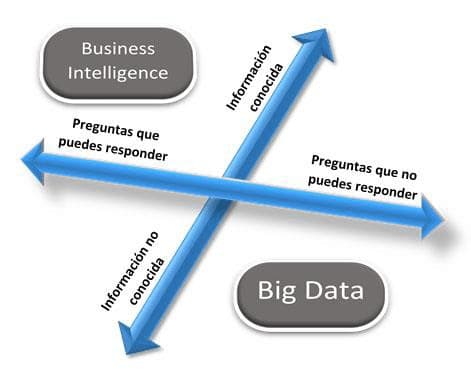
Frequently asked questions
What is the difference between Business Intelligence and Big Data?
Business Intelligence focuses on analyzing structured data for business decisions. Big Data handles large volumes, variety and velocity of data, often using more complex technologies.
When does a company need Business Intelligence?
A company needs Business Intelligence when it wants to consolidate data, create dashboards, monitor KPIs and improve operational or strategic decisions with reliable, accessible information.
When does Big Data make sense?
Big Data makes sense when there are large data volumes, diverse sources, real-time processing or advanced needs such as prediction, personalization or complex pattern detection.
Can Business Intelligence and Big Data be combined?
Yes. Big Data can feed broader analytics systems, while Business Intelligence turns part of that information into understandable indicators for business and management.