What is SEM?
Índice de contenidos
 Once the relevant keywords have been chosen, the advertiser sets the maximum CPC (cost per click) he wants to pay for each word and participates in a bidding system with other advertisers. The goal is for your company’s ads to appear in the first position of the search results or as prominent as possible. To do this, the keywords must be included in your ads and be related to the product you offer on your website.
The cost of keywords depends on the activity of the company and the competition. For example, there are sectors in which the bids are very high and a large investment is required for the ads to be published. This is the case of insurance, marketing and advertising agencies, online education or legal services, among others, activities in which it is not uncommon to encounter irregular practices by the competition, such as fraudulent clicks.
The main characteristic of search engine advertising is that it is positive for both the entrepreneur and the potential customer. On the one hand, the advertiser has the possibility to segment his target audience through precise parameters to directly reach the person likely to make a purchase and, on the other, the user finds ads that respond to a direct search interest.
Once the relevant keywords have been chosen, the advertiser sets the maximum CPC (cost per click) he wants to pay for each word and participates in a bidding system with other advertisers. The goal is for your company’s ads to appear in the first position of the search results or as prominent as possible. To do this, the keywords must be included in your ads and be related to the product you offer on your website.
The cost of keywords depends on the activity of the company and the competition. For example, there are sectors in which the bids are very high and a large investment is required for the ads to be published. This is the case of insurance, marketing and advertising agencies, online education or legal services, among others, activities in which it is not uncommon to encounter irregular practices by the competition, such as fraudulent clicks.
The main characteristic of search engine advertising is that it is positive for both the entrepreneur and the potential customer. On the one hand, the advertiser has the possibility to segment his target audience through precise parameters to directly reach the person likely to make a purchase and, on the other, the user finds ads that respond to a direct search interest.
Ads in Google Ads
If we contemplate SEM only as the advertising that is done in search engines, we are obliged to stop at what Google Ads is and what it represents in the digital marketing sector to better understand this phenomenon. The company that owns the most used search engine in the world (2,000 million users in 2017) realized very soon the potential of a platform like Google Adwords. Specifically, only four years after its foundation (in 2000). At first its name of Adwords responded to the enough that it was only text ads (word = word). However, the emergence of new formats – in which video and images predominate – has forced the Mountain View giant to change its name to Google Ads. You only have to take a look at the figures to understand the current reach of search engine advertising. In 2017, 748 million euros were invested in Spain in this sector, well above the money invested by companies in social networks (415 million), in the classic banners inserted in web pages (313 million) or in videos (122 million), according to data from Statista. Beyond being an activity with an expiration date, forecasts indicate that the volume of business will continue to grow in Europe and the United States at least until 2021. With these figures, which business doesn’t want to be featured prominently in Google Ads? In addition to ADS PPC advertising, Google has a platform designed especially for the promotion of electric commerce products, Google Shopping. They usually appear to the right of the SERP (the list of results linked to a query), but they can also be displayed at the top of the page, even above the ads. A recent modification of Google means that Shopping results always appear in the first position in searches through mobile phones. Google Ads allows you to make search campaigns, which are those that are activated by keywords, but also display. It consists of publications of a certain creativity to a segmented audience on any Internet page that allows it (digital newspapers, specialized publications, etc.). Display campaigns have as their main advantage the possibility of subsequently doing remarketing actions, that is, reaching back users who have already shown some type of interest in the brand. Although many advertisers launch themselves to design their advertising campaigns on the Internet, there are some tricks that every professional knows and that are essential for them to work properly. First of all, it is very important to establish a correct tiered structure (campaign/ad group/ad) that has a parallel with the architecture of the website to which the ads are directed. In addition, we must pay special attention to the quality of the keywords (quality score) and the average position in which our ads appear. Google has recently announced that this last metric will be replaced by others in September 2019. Google Ads ads usually appear at the beginning or end of organic results, labeled with the term ‘ads’. In mobile search, its appearance has recently been similar to the rest of the results and it is foreseeable that the number of clicks from users who will not even be aware that they click on ads will increase.What is SEO?
SEO or Search Engine Optimization is the optimization of websites for search engines. It consists mainly of implementing a series of actions so that the page of a company appears in the first results of the organic search (the one that appears after the ads) for its relevance with respect to the searches of the users. As we will see below, the so-called natural positioning is divided into ONPAGE SEO and OFFPAGE SEO. Despite being a strategy in principle does not need an economic investment, unlike the SEM, it requires a professional and continuous work over time that guarantees success in the battle for the first positions. Each organic results page (SERP) usually offers 10 results, although the number may be smaller depending on the space occupied by the advertising. The goal will always be to appear on the first page, since it is the one that accumulates more than 90% of the click-through rate (CTR). Moreover, studies show that from the fifth result it already drops to less than 5% of CTR and makes the page increasingly invisible. To understand it graphically, just mention the old joke of marketing experts that the best place to hide a corpse is the second page of Google results. Search engines use algorithms to assess which pages should occupy the top positions, based on factors such as the implementation of meta tags (title, description, etc.), web architecture, broad and quality content that responds to the user’s search and a good backlink strategy. Google last modified the main ranking algorithm in March 2019, causing major changes in page positioning. However, the company itself sent a message of reassurance through Twitter in which it indicated that these changes could be reversed over time.
In recent times there has been a phenomenon that has begun to influence the work of SEO professionals. The proliferation of queries through virtual assistants means that the user usually receives only the first result in response to a query and it is strange that he requests a ‘second opinion’ from Siri, Google Assistant or Cortana. Therefore, not being in the first position begins to equate to being invisible (and what is not on the Internet does not exist) and the goal now is to reach the ‘zero position’ or featured snippets.
Google last modified the main ranking algorithm in March 2019, causing major changes in page positioning. However, the company itself sent a message of reassurance through Twitter in which it indicated that these changes could be reversed over time.
In recent times there has been a phenomenon that has begun to influence the work of SEO professionals. The proliferation of queries through virtual assistants means that the user usually receives only the first result in response to a query and it is strange that he requests a ‘second opinion’ from Siri, Google Assistant or Cortana. Therefore, not being in the first position begins to equate to being invisible (and what is not on the Internet does not exist) and the goal now is to reach the ‘zero position’ or featured snippets.
ONPAGE SEO
Onpage SEO encompasses the actions that are carried out on the website itself to try to improve organic positioning. For a site to work properly, it is best to do things right from the beginning, that is, include all the elements that favor SEO since its creation. However, there is always room for improvement and the ideal is to work on the page continuously. The main factors that influence onpage SEO are the following:- The loading speed of the web page: Google penalizes the slowness by interpreting that it does not meet the expectations of the user.
- Meta tags: titles (H) and descriptions help Google bots interpret the page. Keywords and their density in the text: the terms that users are looking for must appear in the desired proportion so that search engines value them positively.
- The text-to-HTML language ratio: extensive, quality content helps position.
- Images: Google analyzes the size, upload speed, and ALT tags of photos.
- URLs: Having a friendly address is critical to SEO. Therefore, it is discouraged that they contain random numbers and it is recommended that they include keywords so that they are easy to remember.
2.2. Offpage SEO
Offpage SEO is one that is done outside the website and that, by its nature, is less controllable (although no less important). The most important action is link building, which consists of getting quality links (from sites with a remarkable authority) that point to our website. The mentions in the media, the viralization of our content through social networks and the publication of press releases can also give a boost to organic positioning. In short, to improve offpage SEO, and if we want to avoid buying links, it is necessary to have quality content that encourages the administrators of other pages to link to ours. To do this, we can launch a blog with careful and interesting texts or look for repercussion in social networks that may lead to a link.Black Hat SEO and White Hat SEO
In SEO, as in any field of marketing, there are unethical techniques and strategies that aim to achieve great results with minimal effort. It is what is called Black Hat SEO and includes actions such as the massive creation of low-quality links in forums, comments on pages and directories, etc. In contrast, Whte Hat SEO is one that is done taking into account the needs of the user instead of only the aspects that search engines value. This strategy includes all the work we have mentioned when talking about onpage SEO: use of the right keywords, an ethical backlinking strategy, quality texts or correct web usability, among others.What are the main differences between SEO and SEM?

Cost
The main difference between SEO and SEM that any professional establishes is the initial investment they require. In this sense, many will say that organic positioning is free and that, on the contrary, advertising needs a budget to start. And it’s true. But let’s put a but: if you want to correctly implement an SEO strategy you have to commission it to a professional. This means that when defining the digital marketing plan of a company, an item should be reserved for this task. However, there are some owners of e-commerce or small businesses who feel empowered to optimize their website in order to work on positioning. In that case, and as long as you work almost blindly and without hiring the advanced measurement tools offered by the market, and that are usually paid, we could say that SEO is completely free.Success deadlines
To explain the time it takes to work one strategy or another we can mention the old tale of the hare and the turtle. SEM delivers optimal results much faster. Therefore, it is ideal for specific campaigns such as Christmas, Black Friday or Valentine’s Day. Also when you want to publicize a product that has just been launched or you need to capture traffic quickly to accelerate sales and get money in order to invest it in SEO. In the fable of digital marketing, SEO is the turtle: without haste but without pause. The work of positioning in search engines depends on several factors, such as the operation of the algorithms used by the search engines, the competition of the sector of the company or the hours of work invested. However, it is proven that a well-done SEO job works best in the long run and lasts over time.Immediacy
This point is closely related to the previous one. In digital marketing, sometimes you need to obtain data immediately to be able to measure the success of a strategy. The difference here is that in SEM the changes are applied almost instantly, while in SEO you have to wait for the tracking of the ‘bots’ that search engines use to index the pages and record the changes. Even if we force this indexing through Google Search Console or other tools, organic results usually vary over time, since they depend largely on the actions of the competition. The fact that the results are practically immediate in the SEM does not mean that a period of time is not needed for a campaign to start. The Google Ads specialist needs to perform trial/error processes to check which words or ads work and how competing businesses react. Once the campaign is optimized, the changes in positions are much faster.Segmentation
PPC advertising is the right strategy for those companies that have perfectly segmented their potential audience and want to reach it directly. Its main advantage is that it allows remarketing actions, or what is the same, to impact again the users who have shown interest in their products or others similar. In the case of SEO, however, the results depend on the behavior in the searches, which can vary from one moment to another.Contents
Another factor that characterizes SEO is that it requires quality content with a significant volume of words. Thus, search engines consider that the page tries to give a broad and complete response to the most common queries of its users and places it in the upper area of the SERP. That’s why SEO is so related to so-called content marketing. In PPC advertising, on the other hand, the ideal is to focus the content of a landing page on the product or service that you want to promote in a campaign. In this way, the texts used in the SEM have a more advertising tone and less service.Keywords
We have already seen before that the choice of keywords or keywords is a primary task that must be done before implementing either of the two strategies. The difference between SEM and SEO is that search engine advertising supports an unlimited number of keywords, while in organic positioning you have to focus on a group of terms to be successful. There is no other option: in SEO it is necessary to bet. Trying to position a page by a very wide group of keywords does not make sense because Google and other search engines take into account the density or the proportion in which those words appear in proportion to the rest of the text. If our purpose is to attack other terms, the solution will be the creation of new pages with quality content or a blog with periodic publications. The choice of words is simpler in SEM, although it is also not accurate to say that it is ‘unlimited’. The keywords purchased in Google Ads for a page to appear for those searches must be relevant and related to the content of the landing page to which the ads point so that the search engines do not penalize us.CTR
The CTR or click through rage is the percentage of clicks that occurs in an ad with respect to the number of impressions (the times that users see that ad). It is a fundamental metric in digital marketing and also a differential factor between the two strategies that we are analyzing in detail. In SEO, the various studies on the subject ensure that appearing in the first position of the SERP supposes an average CTR of 30%, so the chances of a user accessing our website are very high. However, appearing from the fifth position lowers the CTR to 5% and, from there, the click-through rate plummets and drops to 1% on the second page of the results. Although there are still few analyses about it, appearing in the first place will be even more priority with the generalization of voice searches and personal assistants, which remain in the first result and ignore the rest. CTR is a decisive metric also for SEM, although there is some margin here and it may be enough to appear prominent in one of the four ads that are displayed above organic results.Ranking
The hard work that SEO requires leads to a positive conclusion: organic positions usually vary much less than those of ads, as long as the page is not affected by one of the algorithm changes that search engines introduce several times a year. Google, without going any further, has introduced its last modification in March 2019, with notable changes in the positioning that, according to the company, will be corrected over time. If the sharp variations in SEO are punctual, SEM experts work every day with fear that a competing company has moved its ads below the SERP or even to the second page.Metric
The ease of measuring PPC actions is linked to some extent to the immediacy with which we mentioned that changes are applied. SEM is always easier to control, which is not to say that it is easier to perform. The Google Ads platform itself offers numerous metrics regarding a campaign’s ads and keywords. To monitor organic positioning there are tools such as SemRush or Ahrefs with payment plans aimed at professionals that offer very valuable data, but that must always be compared with the results of Google Analytics and Google Search Console.Which strategy to choose? SEO or SEM?
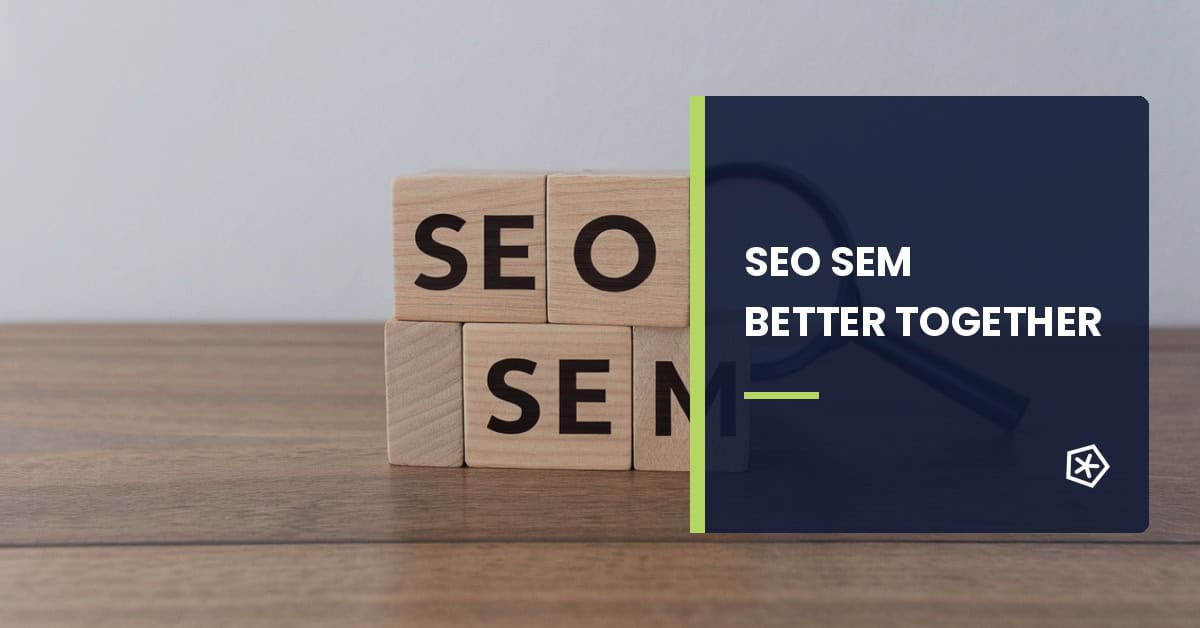
 We repeat ourselves, but sometimes it is necessary: the one cannot live without the other. PPC advertising is more effective if implemented correctly. However, SEO is cheaper and gives relevance to the web (there are still users reluctant to click on ads, although the proportion is getting smaller). The most successful strategy is to combine both,given that user behavior is still uncertain: some click on advertising without knowing that it is and others avoid precisely these results.
They have as common points:
We repeat ourselves, but sometimes it is necessary: the one cannot live without the other. PPC advertising is more effective if implemented correctly. However, SEO is cheaper and gives relevance to the web (there are still users reluctant to click on ads, although the proportion is getting smaller). The most successful strategy is to combine both,given that user behavior is still uncertain: some click on advertising without knowing that it is and others avoid precisely these results.
They have as common points:
- The need to define the objectives in advance in a clear and concise way.
- A medium/long-term planning so as not to be overwhelmed with obtaining results. Scope for action to modify and perform A/B tests.
- The obligation to have a perfectly structured website that meets the user’s expectations: you want to find just what you are looking for.
- Work on optimization on a regular basis. A previous work is done to implement SEO or SEM and then it is constantly measured and reviewed to detect failures or chances of success.
Frequently asked questions
What is the difference between SEO and SEM?
SEO improves organic visibility in search engines through content, technical work and authority. SEM usually refers to paid search campaigns. SEO works over the medium and long term; SEM generates immediate visibility with investment.
When should SEO be used and when should SEM be used?
SEO fits sustainable traffic, authority and continuous acquisition. SEM fits quick campaigns, demand testing, launches or high-intent searches. In many cases, both channels are combined.
Do SEO and SEM compete with each other?
Not necessarily. They can complement each other: SEM provides fast keyword and conversion data, while SEO reduces paid dependency and improves organic coverage. Coordination is essential.
Which channel is more profitable, SEO or SEM?
It depends on industry, competition, margin and time horizon. SEM offers immediate cost control, but traffic stops when investment stops; SEO takes longer, but can accumulate profitability over time.