
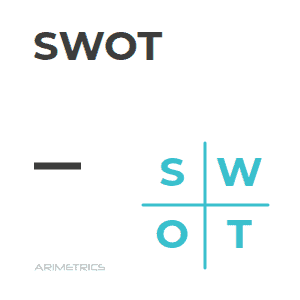
 Definition:
SWOT is an analytical tool that organises the strengths, weaknesses, opportunities and threats relevant to an organisation, project or decision. It relates internal circumstances to external conditions to guide planning and assess possible actions.
The Spanish equivalents are DAFO, FODA and DOFA. SWOT stands for strengths, weaknesses, opportunities and threats. Strengths and weaknesses are internal factors; opportunities and threats arise from the external environment. Their classification depends on the objective and scope of the analysis.
The result is usually presented in a four-part matrix. This representation summarises the assessment, but it does not replace research or constitute a strategy on its own.
Table of contents
Origins of SWOT analysis
The development of SWOT is linked to corporate strategic planning in the second half of the twentieth century. Its history has been associated with Albert S. Humphrey and work at the Stanford Research Institute, although attributing the entire method to a single creator simplifies an evolution involving various researchers, consultants and executives.
A historical reconstruction of the SOFT approach and its relationship with SWOT examines its development from the 1960s to the 1980s. It places these tools within broader planning frameworks, rather than treating SWOT as an isolated matrix that emerged on a single date.
SWOT analysis in business
SWOT helps identify which capabilities support an objective, which limitations make it harder to achieve and which external changes may affect the outcome. It can be applied to the company as a whole, a business line, a product launch or entry into a market.
Before preparing it, the question, scope and time horizon should be defined. An analysis to decide on international expansion does not require exactly the same factors as one intended to improve an existing service.
Statements should be specific and supported, where possible, by data, documents or verified experience. Expressions such as "good quality" or "strong competition" add little unless the reference points used to assess them are explained. Benchmarking can help assess certain capabilities or results against comparable reference points.
The analysis involves judgement and can contain biases. It is therefore useful to distinguish facts, interpretations and hypotheses, gather perspectives from different departments and prioritise the factors that genuinely affect the decision. A longer list does not necessarily mean a better assessment.
Weaknesses, threats, strengths and opportunities
The four components combine the source of a factor with its effect on the objective. An internal factor is not necessarily something the company can change immediately; an external factor does not mean the company cannot prepare for its effects.
Each section covers a different type of information:
- Weaknesses: internal limitations that hinder the objective. Examples include insufficient production capacity, a lack of funding or dependence on knowledge concentrated in one person.
- Threats: external conditions that may harm the organisation. A drought can threaten an agricultural producer; a rise in raw material costs can affect a manufacturer. The threat should be distinguished from internal limitations in responding to it.
- Strengths: internal capabilities or resources that support the objective, such as specialist expertise, reliable processes or a suitable distribution network. They should be assessed in context and against relevant reference points, rather than as positive qualities unrelated to the decision.
- Opportunities: favourable external conditions that the organisation could take advantage of. A reduction in tariffs may facilitate entry into a market, but does not guarantee sales: capacity, demand and a suitable offering are also needed.
The same change can represent an opportunity for one company and a threat to another. For example, a new technical requirement may benefit a prepared supplier while creating difficulties for another that needs to adapt its processes.
Internal and external analysis
Internal analysis examines the organisation’s resources, capabilities and limitations. The following five factors may be reviewed:
- Production and operations: capacity, quality, costs, lead times and service continuity.
- Marketing and sales: customer understanding, positioning, channels and commercial results.
- Organisation: coordination, responsibilities and the ability to make and implement decisions.
- People: skills, experience, availability and training needs.
- Financial resources: liquidity, funding and the capacity to handle investment or unexpected events.
External analysis examines conditions that do not depend solely on the organisation. These can be grouped into four areas:
- Market: demand, customer needs and changes in purchasing habits.
- Industry: suppliers, distributors, barriers to entry and developments in the sector.
- Competition: available alternatives, other operators’ capabilities and substitute products.
- Wider environment: relevant economic, technological, regulatory, social and environmental factors.
The two analyses complement each other and can be reviewed iteratively. Information should correspond to the defined scope and period; combining outdated data with unidentified expectations can distort the assessment.
Strategies following SWOT analysis
The objective is defined before the analysis; strategic alternatives are assessed using its results. There is no need to decide in advance which strategy the SWOT analysis should justify.
Combining internal and external factors allows four types of action to be considered:
- Defensive strategies: use strengths to reduce exposure to threats. For example, relying on a diversified supplier network to respond to supply disruptions.
- Offensive strategies: use strengths to develop opportunities. These are not exclusive to market leaders: a specialist organisation may serve new demand for which it already has the necessary capacity.
- Reorientation strategies: address weaknesses that prevent opportunities from being pursued. It may be necessary to acquire skills, improve a process or establish a partnership before entering a market.
- Survival strategies: reduce weaknesses and exposure to threats when continuity is at risk. These may include adjustments to operations, protection of liquidity or contingency plans; waiting without acting is not a general recommendation.
These combinations generate alternatives, not automatic decisions. Turning them into a plan requires assessing feasibility, prioritising actions, assigning responsibilities and resources, and setting monitoring criteria. The SWOT analysis should be reviewed when the conditions underlying the assessment change.