
 Definition:
The customer journey is the sequence of experiences a person has with an organization before, during, and after acquiring or using a product or service. It includes the person’s actions, goals, questions, emotions, and difficulties, as well as the digital, physical, and human touchpoints involved in the journey.
The journey does not necessarily begin with a campaign or end with a purchase. It may start when a need emerges, continue through searches, comparisons, and conversations, and extend into use, support, renewal, or recommendation. Each customer may follow a different path and move between channels several times.
Customer journey and customer journey map
The customer journey is the actual experience a person goes through. A customer journey map is its structured visual representation, created to examine what happens at each moment and connect it with the organization’s response.
A map may show stages, actions, needs, expectations, emotions, friction points, channels, and internal owners. Its level of detail depends on the purpose, such as analyzing a complete purchase, examining onboarding to a service, or understanding a specific customer support interaction.
The map is not an automatic description of every customer. It normally represents a defined segment, context, and scenario. When it is based only on internal assumptions, it remains a hypothesis that should be tested against information from real users.
Common journey stages
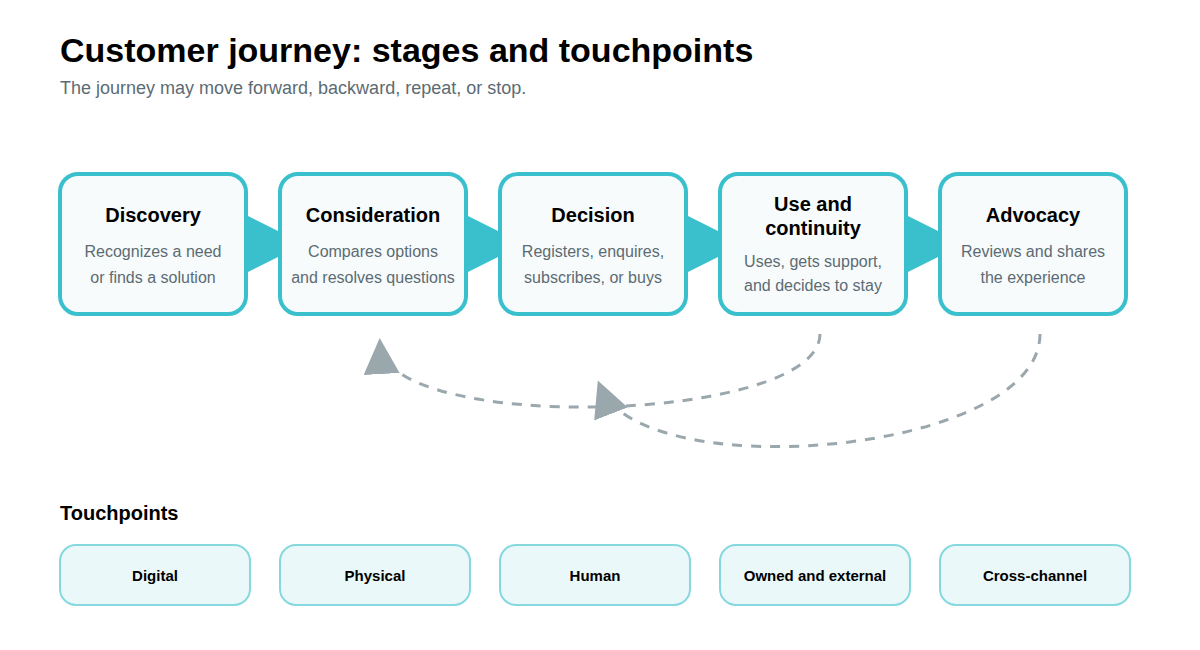
Stages help organize the analysis, but they do not form a universal sequence. A common model distinguishes these moments:
- Discovery: A person recognizes a need or encounters a possible solution through search, recommendations, advertising, or content.
- Consideration: The person compares alternatives, reviews information and conditions, and evaluates whether an option meets the identified need.
- Decision: The person selects a solution and completes an action such as registering, requesting information, subscribing, or purchasing.
- Use and continuity: The customer receives the product or service, learns to use it, seeks assistance, and decides whether to continue, renew, or leave.
- Advocacy: The customer shares an experience, publishes a review, or recommends the solution after perceiving value.
The journey may move backward, repeat, or stop. A person can resume comparison after starting a purchase, use several products at once, or return to discovery when circumstances change.
Touchpoints and channels
A touchpoint is any interaction that influences the experience. It may be a search result, review, store visit, telephone conversation, email, package, invoice, or response to a support request.
A channel and a touchpoint are not the same thing. Email is a channel, while an order confirmation, support message, and renewal notice are different touchpoints within that channel. Each serves a different need and can create a different perception.
The analysis also includes interactions that the organization does not directly control, such as recommendations, public comments, or comparison services. In an omnichannel journey, continuity depends on channels sharing enough context so the person does not have to restart the process.
Components of a journey map
A useful customer journey map connects the customer’s perspective with the processes that support the experience. Common components include:
- Persona and scenario: The segment being studied, its initial need, and the situation in which the journey occurs.
- Stages: Moments that organize the experience without assuming that every user progresses in a straight line.
- Actions: Observable behaviors such as searching, comparing, asking, purchasing, configuring, or requesting help.
- Goals and questions: The outcome the person is trying to achieve and the information needed at each stage.
- Emotions and friction: Perceptions, unmet expectations, and obstacles that help or hinder progress.
- Touchpoints and owners: The interactions, channels, teams, and systems involved in the organization’s response.
Some maps also add metrics, opportunities, or internal processes. When the analysis focuses on visible and backstage service activities, roles, and operational dependencies, it may take the form of a service blueprint.
Information sources and measurement
A map may combine interviews, surveys, observation, usability tests, support requests, reviews, sales data, and channel analytics. No single source describes the entire experience: behavioral data shows what happened, while qualitative research helps explain expectations and motives.
Metrics should correspond to the stage and objective being studied. They may include task completion, abandonment, resolution time, repeated contacts, returns, retention, or satisfaction. A conversion alone does not show that the journey was easy or that the relationship will continue.
Connections between interactions across devices and channels may be incomplete. Analysis should respect stated purposes, the applicable legal basis, and consent, rather than turning the map into a mechanism for indiscriminate tracking.
The buyer’s journey focuses mainly on the buyer’s decision process from recognizing a problem to choosing a solution. The customer journey has a broader scope and may include use, support, renewal, abandonment, and advocacy.
A funnel organizes a population into aggregated stages and measures how many people progress toward an outcome. The customer journey describes paths, needs, and touchpoints from the customer’s perspective. A funnel summarizes volumes; a journey map explains experiences and relationships between interactions.
A map is also different from a buyer persona. A persona describes relevant patterns within a group, while the map places those patterns within a specific scenario and sequence. The two can be used together, but the same profile may follow different journeys depending on its need or context.
Scope of the analysis
The customer journey can reveal friction, duplicated work, breaks between channels, and differences between what an organization promises and what a person experiences. It can also help coordinate teams when several areas participate in the same journey.
Its conclusions depend on the quality and recency of the evidence. A map based only on internal opinions can reinforce incorrect assumptions, while an overly general map can hide important differences among segments and situations.
The journey changes as channels, products, regulations, and behaviors evolve. A customer journey map therefore represents a scenario during a particular period and should be reviewed when evidence indicates material changes.