 Definition:
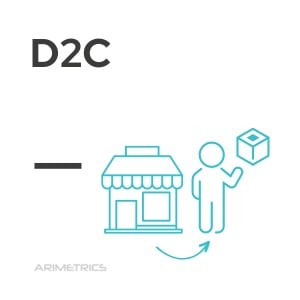
D2C stands for direct-to-consumer. It describes a model in which a brand or manufacturer sells its products directly to the end consumer without an independent retailer or wholesaler controlling the sale.
The business manages the commercial relationship and makes decisions about the offer, price, presentation, and service. It may rely on payment, logistics, technology, or advertising providers without ceasing to operate as D2C. It does not have to sell only online either: a brand may combine ecommerce and company-owned shops within a direct relationship.
Índice de contenidos
How the D2C model works
The model concentrates functions within the brand that a conventional chain divides among a manufacturer, distributor, and retailer. Its scope varies: some businesses design and manufacture their products, while others outsource production and retain control of the brand and sale.
The operation commonly includes these components:
- Owned offer: The business defines the range, positioning, and conditions presented to consumers.
- Controlled channel: The transaction takes place through a website, app, company-owned shop, or another sales point managed by the brand.
- Commercial relationship: The business supports the buyer, manages returns, and retains permitted information about the interaction.
- Connected operation: Inventory, payments, fulfilment, delivery, and support must work together even when external providers participate.
Ecommerce enables many D2C operations, but it does not define them. An online shop that sells products from many manufacturers acts as a retailer, while a brand may sell directly through its own physical store.
Differences from other models
D2C addresses who produces or controls the brand and who makes the consumer sale. This perspective separates it from related concepts that classify the buyer, channel, or acquisition strategy.
B2C covers any sale from a business to an individual consumer, including transactions involving shops, distributors, or platforms. D2C is therefore a form of B2C with a more direct commercial relationship between the brand and buyer.
DTC marketing comprises the activities used to create demand and maintain that relationship, but it is not the distribution model itself. A marketplace brings sellers together within a shared platform and may influence visibility, ordering, or payment. Direct selling through independent representatives is another system and is not automatically synonymous with D2C.
Required capabilities
Removing commercial distributors does not remove their functions. The brand must perform them or appoint providers while retaining the ability to supervise service. Growth may require systems, people, and capital before economies of scale appear.
The main capabilities include:
- Demand management: The brand needs to attract buyers, explain its proposition, and balance acquisition, repeat purchases, and profitability.
- Data and systems: Catalogue, orders, inventory, consent, support, and measurement need reliable and protected information.
- Operational compliance: Delivery, returns, warranties, tax, privacy, and security require processes suited to each market.
Direct access to customer information may improve commercial understanding, but it depends on data quality, a lawful basis, and the ability to interpret it. Owning a shop does not automatically make every interaction useful data or authorize every subsequent use.
Benefits and costs
D2C may provide greater control over presentation, product range, and service. It may also allow a business to test offers and receive feedback without waiting for a retailer’s decision. These possibilities depend on execution and do not guarantee loyalty, innovation, or a better experience.
Economic decisions should consider at least these factors:
- Margin and costs: The brand avoids part of a third party’s commercial margin but assumes acquisition, technology, fulfilment, delivery, returns, and support.
- Control and reach: Owned channels provide more decision-making power, while retailers may offer distribution, trust, and established audiences.
- Speed and risk: A direct relationship enables testing, but rapid change without sufficient demand may increase inventory, service issues, or advertising dependence.
Profitability should be assessed through contribution margin, acquisition cost, repeat purchasing, returns, service, and customer value. Retaining more of the selling price does not by itself mean a higher profit.
Hybrid distribution
Many brands combine D2C with retailers, distributors, or platforms. Warby Parker developed company-owned shops alongside its digital channel; Harry’s expanded into retail; and Glossier added distribution through Sephora. These paths show that D2C can be the origin or one part of a hybrid strategy.
Casper and Dollar Shave Club also helped popularize the model through online sales, subscriptions, or a brand-led proposition. Business operations, ownership, and channels change, however. A brand that started as D2C does not necessarily retain exclusively direct distribution.
The appropriate combination depends on the product, purchase frequency, logistics cost, need for physical trial, and desired reach. Adding intermediaries may reduce control at some points, but it can also increase availability. The classification should apply to the specific sale, not as a permanent label for the whole company.