
 Definition:
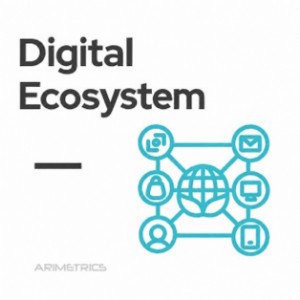
A digital ecosystem is a set of people, organizations, technologies, channels and data connected through digital processes to carry out activities, exchange information or offer products and services.
Within a company, it includes both its own resources and its connections with customers, suppliers and external services. What defines it is not the number of tools available, but the relationships and dependencies among its participants.
Table of contents
Which elements make up a digital ecosystem
Its composition depends on the activity and the scope being analyzed. The following elements can be distinguished within an organization’s environment:
- People and organizations: customers, employees, collaborators and suppliers involved in the processes.
- Channels and touchpoints: websites, applications, email, social media and other spaces for interaction.
- Management systems: applications that organize content, orders, contacts, inventory or customer service.
- Data and content: information created, consulted or exchanged during an activity.
- Infrastructure: hosting, networks and technical services that allow applications to run and be accessed.
- Processes and rules: responsibilities, permissions and procedures that determine how these resources are used and connected.
Not all of these elements belong to the same company. An organization may manage its website while relying on one provider for payments, another for deliveries and external platforms for part of its communication.
How its components connect
Connections allow an action to continue in other systems or teams. In an online store, for example, an order can communicate the payment result, update inventory and pass the necessary information to the delivery service.
An API allows different applications to exchange information or request operations through a defined interface. Connectors, shared files or manual procedures can also be used.
Interoperability means that systems can exchange information and use it correctly. Transmitting data is not enough: aspects such as product identifiers, order statuses and the meaning of each field must be consistent.
Cloud computing services make resources and applications accessible over a network, but do not guarantee that they are all compatible with one another. Connections require configuration, maintenance and designated owners.
Relationship with marketing strategy
Analyzing the digital ecosystem helps explain how communication, customer acquisition, sales and after-sales support relate to one another. A campaign may attract visits, but its outcome also depends on what happens on the website and how inquiries are handled.
The website is often an important touchpoint, although it does not have to be the center of every interaction. A purchase or inquiry can begin and be completed through other channels.
Having a presence across several channels does not necessarily mean offering a coordinated experience. An omnichannel approach seeks to provide continuity between interactions across channels; the digital ecosystem also encompasses the systems, participants and processes that can make this possible.
Social media and other external platforms are part of that environment, but the organization does not control their rules, availability or all the conditions governing access to information.
An organization’s ecosystem and a platform ecosystem
The term can be used at different scales. Discussing a company’s digital ecosystem allows its channels, systems and operational relationships to be examined.
In a platform ecosystem, several organizations or groups of users participate around shared infrastructure or a common service. A marketplace, for example, connects buyers, sellers and service providers through rules of participation.
The two approaches can overlap: a company can have its own digital environment and participate in ecosystems managed by third parties.
A digital ecosystem is not an inventory of applications: it also includes the rules, contributions and dependencies that connect its participants.
How to review and improve a digital ecosystem
An ecosystem map helps represent its components and connections. To be useful, it should show the role of each element, who uses it and who is responsible for maintaining it.
The review can focus on these questions:
- Process continuity: where a task is interrupted or the same information is entered several times.
- Data quality: which records are duplicated, outdated or have incompatible meanings.
- Dependencies: what happens if a provider fails or changes its service conditions.
- Access and privacy: which information each participant needs and which permissions allow them to use it.
- Usefulness of connections: which integrations meet a real need and which add unnecessary complexity.
When difficulties are identified in the purchasing journey, CRO can help investigate and test specific improvements. Inventory, support and information exchange problems also require reviewing the corresponding processes.
A digital ecosystem does not need to connect all its data or automate every task. The priority is for the necessary relationships to work in a way that is understandable, maintainable and suited to the organization’s objectives.