
Definition:
Copyleft is a creation license that consists of releasing a computer program, a work of art or any other type of document for copying, modification and redistribution. It is a legal practice that is carried out in the exercise of copyright. To call it his uses a play on words, since copyleft is the contrast of copyright, whose meaning in English is ‘copyright’. In this case, the terms ‘left’ and ‘right’ are used, but also the participle of leave (lefy), translated as ‘left’.
The Copyleft Foundation defines these licenses as “those that allow greater control of creators over their works, research and projects and a more reasonable compensatory remuneration for their work, also allow end users better access and enjoyment of goods under this type of non-restrictive licenses.”
In short, copyleft licenses are authorized by the author of the work himself so that they can be used and modified by a large number of users. They are the main example of free licenses, which does not necessarily equate to them being free.
Índice de contenidos
Origin of Copyleft
Its origin is in the GNU General Public License (GPL) created by Richard Stallman in the eighties, after a conflict over the rights of a software. Its philosophy is to release computer programs for successive modifications, but it makes it clear that they must carry a copyleft license so that the one who has made the changes cannot limit access to the rest of the users to the new version.
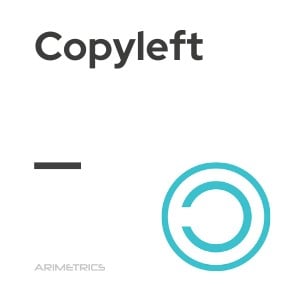
It is represented with a symbol inverse to that of copyright, which in plain text translates into an inverted c and in parentheses “(ɔ)”.
Copyleft is a creation license that consists of releasing a computer program, a work of art or any other type of document for copying, modification and redistribution. It is a legal practice that is carried out in the exercise of copyright. To call it his uses a play on words, since copyleft is the contrast of copyright, whose meaning in English is ‘copyright’. In this case, the terms ‘left’ and ‘right’ are used, but also the participle of leave (lefy), translated as ‘left’.
Copyleft Foundation
The Copyleft Foundation defines these licenses as “those that allow greater control of creators over their works, research and projects and a more reasonable compensatory remuneration for their work, also allow end users better access and enjoyment of goods under this type of non-restrictive licenses.”
In short, copyleft licenses are authorized by the author of the work himself so that they can be used and modified by a large number of users. They are the main example of free licenses, which does not necessarily equate to them being free.
Its origin is in the GNU General Public License (GPL) created by Richard Stallman in the eighties, after a conflict over the rights of a software. Its philosophy is to release computer programs for successive modifications, but it makes it clear that they must carry a copyleft license so that the one who has made the changes cannot limit access to the rest of the users to the new version.
It is represented with a symbol inverse to that of copyright, which in plain text translates into an inverted c and in parentheses “(ɔ)”.